As discussed in the first installment of this Health Capital Topics series, neurological services are characterized by rising demand and a constrained supply of neurologists, trends expected to continue as the U.S. population ages.1 This second instalment examines the reimbursement environment applicable to neurological services, including the Medicare Physician Fee Schedule (MPFS) payment framework, telehealth reimbursement policy, and neurological services-specific considerations arising from recent and forthcoming Centers for Medicare & Medicaid Services (CMS) rulemaking.
The U.S. government is the largest payor of medical costs through Medicare and Medicaid and exerts significant influence over physician reimbursement. In 2024, Medicare and Medicaid spending reached $1.1 trillion and $931.7 billion, respectively, representing 21% and 18% of total U.S. healthcare spending and reflecting increases of 7.8% and 6.6% over 2023.2 The prevalence of these public payors in the healthcare marketplace often results in their acting as a price setter and benchmark for private reimbursement rates.
Medicare pays for physician services through the MPFS, which calculates payments according to the Resource-Based Relative Value Scale (RBRVS) system. Under this system, each procedure in the MPFS is assigned relative value units (RVUs) for three categories of resources:
Physician work (wRVUs), representing the physician’s contribution of time and effort to a procedure;
Practice expense (PE RVUs), based on direct and indirect practice expenses, including clinical labor, medical supplies, medical equipment, and administrative overhead; and
Malpractice expense (MP RVUs), corresponding to the relative malpractice costs of a given procedure.
Each procedure’s RVUs are adjusted for local geographic differences using Geographic Practice Cost Indices (GPCIs) across 112 Medicare payment localities,3 then summed and multiplied by a conversion factor (CF) to yield the Medicare payment amount:
Payment = [(wRVU × GPCI Work) + (PE RVU × GPCI PE) + (MP RVU × GPCI MP)] × CF.4
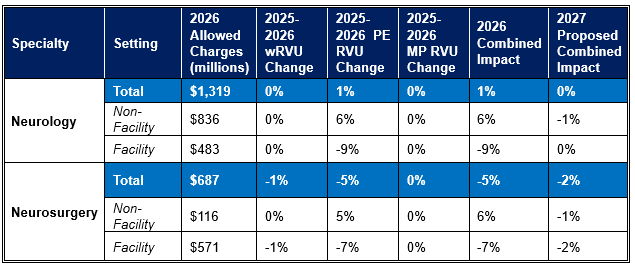
The CF is updated annually pursuant to a schedule established by the Medicare Access and CHIP Reauthorization Act (MACRA). Payment rates were cut for the fifth consecutive year in 2025, with the CF decreasing 2.83% from 2024.5 Beginning in 2026, MACRA provides for two separate CFs: a 0.75% update for Advanced Alternative Payment Model (APM) participants and a 0.25% update for Merit-based Incentive Payment System (MIPS) participants and other non-APM participants. CMS finalized 2026 CF increases to $33.57 (+3.77%) for qualifying APM participants and $33.40 (+3.26%) for non-qualifying participants, reflecting these statutory updates, a one-time 2.5% increase enacted under the One Big Beautiful Bill Act (OBBBA),6 and a 0.49% budget-neutrality adjustment.7 As set forth in Table 1 below, the 2026 MPFS adjustments yielded a combined payment impact of 1% for neurology and negative 5% for neurosurgery; the 2027 proposed rule, which was published in July 2026, would narrow these impacts to 0% and negative 2%, respectively.
On July 14, 2026, CMS released the 2027 MPFS proposed rule, proposing to decrease both CFs and reversing the prior year’s increase. CMS proposes a qualifying APM conversion factor of $33.17, a decrease of $0.40 (-1.19%) from the current $33.57, and a non-qualifying APM conversion factor of $32.84, a decrease of $0.56 (-1.68%) from the current $33.40, driven primarily by the scheduled expiration of the OBBBA’s one-time 2.5% CF increase, which applied only to 2026 and will not recur in 2027.9 For further discussion of the proposed rule’s broader payment implications, see the companion article in this issue.10
Several provisions of the 2027 proposed rule carry particular relevance for neurological services. CMS proposes to transition the office/outpatient evaluation & management (E/M) visit complexity add-on (HCPCS code G2211) from a flat-rate add-on code to a modifier appended to the associated E/M base code, increasing payment for the underlying E/M visit by 16%.11 Neurologists, who routinely provide longitudinal care for complex chronic conditions such as epilepsy, Parkinson’s disease, multiple sclerosis, and dementia, are among the specialties most reliant on this add-on and therefore most likely to be affected by the proposed modifier transition.12
CMS also proposes to reduce payment to 50% for a same-day office/outpatient E/M visit furnished alongside a 0-, 10-, or 90-day global procedure, with the more expensive of the two services paid at 100%. Neurologists who perform botulinum toxin injections for movement disorders, spasticity, or migraine prevention alongside an E/M visit in the same encounter would be directly affected by this proposed change.
The proposed rule further imposes new restrictions on remote physiologic monitoring (RPM) and remote therapeutic monitoring (RTM) services, requiring that RTM be furnished only to established patients, that a separately reportable initiating visit be furnished at the onset of monitoring, and that monitoring services be performed by clinical staff employed by the billing practice rather than by contractors.13 These proposed changes carry meaningful implications for neurologists who rely on remote monitoring tools for epilepsy, Parkinson’s disease, tremor, and other neurological conditions.
Separately, beginning January 1, 2027, neurosurgeons treating low back pain in CMS-designated geographic areas will be subject to mandatory participation in the Ambulatory Specialty Model (ASM), a five-year value-based payment model under which Medicare Part B payments are adjusted based on quality and cost performance relative to peers.14 Market analysts have identified neurology as a candidate specialty for future expansion of the ASM or similar value-based specialty models, though CMS has not yet proposed such an expansion.
Medicare telehealth reimbursement is likewise governed by the MPFS. Prior to the COVID-19 public health emergency (PHE), Medicare telehealth coverage was narrow, generally limited to established patients located at rural originating sites; CMS relaxed these restrictions during the PHE and expanded the list of Medicare-covered telehealth services by approximately 135 services.15
The major telehealth flexibilities adopted during the PHE have since been extended through December 31, 2027, pursuant to the Consolidated Appropriations Act, 2026.16 As telehealth continues to expand in scope and coverage, it is likely to create new opportunities for neurologists to extend access to care while reducing barriers associated with in-person visits; meaningful barriers to broader teleneurology adoption remain, however, including inconsistent reimbursement across payors, multi-state licensing burdens, and credentialing complexities.
Medicare reimbursement dynamics, including CF volatility, wRVU adjustments, expanding telehealth policy, and the proposed 2027 payment reductions following the scheduled expiration of the OBBBA’s one-time increase, remain central drivers of the financial viability of neurological services and bear directly on Fair Market Value (FMV) analyses of neurological service arrangements. Whether Congress will act before the end of 2026 to extend or replace the expiring CF increase – as it has for prior temporary payment adjustments – is an open question with direct implications for physician compensation planning. The third installment of this series will examine the regulatory environment applicable to neurological service arrangements, including the federal Anti-Kickback Statute and the Stark Law.
“A Shortage of Neurologists — We Must Act Now: A Report From the AAN 2019 Transforming Leaders Program” By Jennifer J. Majersik, et al., Neurology, Vol. 96, No. 24 (April 30, 2021), https://n.neurology.org/content/96/24/1122 (Accessed 7/20/26).
“National Health Expenditures 2024 Highlights” Centers for Medicare & Medicaid Services, Office of the Actuary, 2025, https://www.cms.gov/files/document/highlights.pdf (Accessed 7/21/26).
“Medicare PFS Locality Configuration” Centers for Medicare & Medicaid Services, https://www.cms.gov/medicare/payment/fee-schedules/physician/locality-configuration (Accessed 7/21/26).
“Medicare Physician Fee Schedule” Centers for Medicare & Medicaid Services, https://www.cms.gov/medicare/payment/fee-schedules/physician (Accessed 7/21/26).
“Calendar Year (CY) 2025 Medicare Physician Fee Schedule Final Rule” Centers for Medicare & Medicaid Services, Fact Sheet, November 1, 2024, https://www.cms.gov/newsroom/fact-sheets/calendar-year-cy-2025-medicare-physician-fee-schedule-final-rule (Accessed 7/21/26).
“Calendar Year (CY) 2026 Medicare Physician Fee Schedule Final Rule (CMS-1832-F)” Centers for Medicare & Medicaid Services, Fact Sheet, October 31, 2025, https://www.cms.gov/newsroom/fact-sheets/calendar-year-cy-2026-medicare-physician-fee-schedule-final-rule-cms-1832-f (Accessed 7/21/26); “One Big Beautiful Bill Act” Pub. L. No. 119-21, § 71202, 139 Stat. 72 (July 4, 2025).
Centers for Medicare & Medicaid Services, Fact Sheet, October 31, 2025.
“Calendar Year (CY) 2026 Medicare Physician Fee Schedule Final Rule (CMS-1832-F)” Federal Register, Vol. 90, No. 212 (November 5, 2025), p. 49965; “Calendar Year (CY) 2027 Medicare Physician Fee Schedule Proposed Rule (CMS-1848-P)” Federal Register (July 16, 2026).
“CMS Issues CY 2027 Medicare Physician Fee Schedule Proposed Rule” Holland & Knight LLP, July 2026, https://www.hklaw.com/en/insights/publications/2026/07/cms-issues-cy-2027-medicare-physician-fee-schedule-proposed-rule (Accessed 7/21/26).
“2027 Proposed Physician Fee Schedule Cuts Payments” Health Capital Topics, Vol. 19, Issue 7 (July 2026).
“CMS Proposes Pay Cut for Docs in 2027, Plans to Phase Out MIPS” By Emma Beavins, Fierce Healthcare, July 2026, https://www.fiercehealthcare.com/regulatory/cms-proposes-major-medicare-reforms-phase-out-traditional-mips-expand-aco-participation (Accessed 7/21/26).
“HCPCS Add-on Code G2211 Frequently Asked Questions” Centers for Medicare & Medicaid Services, https://www.cms.gov/files/document/hcpcs-g2211-faq.pdf (Accessed 7/21/26).
“Calendar Year (CY) 2027 Medicare Physician Fee Schedule Proposed Rule” Centers for Medicare & Medicaid Services, Fact Sheet, July 14, 2026, https://www.cms.gov/newsroom/fact-sheets/calendar-year-cy-2027-medicare-physician-fee-schedule-proposed-rule (Accessed 7/21/26).
“Ambulatory Specialty Model” Center for Medicare and Medicaid Innovation, Centers for Medicare & Medicaid Services, Fact Sheet, https://www.cms.gov/files/document/asm-model-fact-sheet.pdf (Accessed 7/21/26).
“Telehealth Services” Medicare Learning Network, Centers for Medicare & Medicaid Services, https://www.kff.org/wp-content/uploads/sites/3/2015/06/telehealthsrvcsfctsht.pdf (Accessed 7/21/26).
“Telehealth Policy Updates” Telehealth.HHS.gov, U.S. Department of Health and Human Services, https://telehealth.hhs.gov/providers/telehealth-policy/telehealth-policy-updates (Accessed 7/21/26).