As discussed in the first installment of this five-part Health Capital Topics series regarding the valuation of orthopedic services, musculoskeletal disorders (MSDs) affect approximately 126.6 million Americans, representing roughly one in two adults, and generate healthcare costs exceeding $980 billion annually.1 The prevalence of these conditions, particularly arthritis, is expected to increase substantially over the coming decades as the population ages. This second installment examines the competitive environment for orthopedic services, including the demand for orthopedic services, the supply of orthopedic surgeons, and the factors driving the supply-demand imbalance in this specialty.
Demand for orthopedic services is on the rise, driven by the continued variety of services required by patients of all ages. The aging population, in particular the Baby Boomer generation, is increasing the demand for orthopedic services. The elderly population utilizes a greater proportion of (and expenditures related to) medical services relative to the rest of the general population, and as such may comprise a growing part of the orthopedic patient population in future years, particularly in consideration of the fact that age increases the risk of certain conditions, such as arthritis, that require orthopedic services.
Increases in the health factors and conditions that contribute to MSDs will also drive demand for orthopedic services. Numerous health conditions, obesity in particular, can increase patients’ risk of developing various MSDs. Additionally, health behaviors such as smoking, alcohol use, and poor diet can also contribute to the development of MSDs. Adult obesity reached 40.3% in the U.S. according to National Health and Nutrition Examination Survey (NHANES) 2021-2023 data, with severe obesity affecting 9.4% of adults.2 Obesity prevalence varies regionally, with West Virginia demonstrating the highest obesity rate in the U.S. at 41.4% and Colorado demonstrating the lowest rate at 25.0%.3 The 40-59 age cohort has the highest obesity rate (46.4%), directly corresponding to the demographic most likely to require joint replacement within the next two decades.4
The orthopedic surgeon supply-demand imbalance represents one of the most significant challenges facing healthcare systems. According to data from the Association of American Medical Colleges (AAMC), there were approximately 19,344 active orthopedic surgeons practicing in the U.S. in 2023.5 Approximately 32.3% of practicing orthopedists were aged 65 or older in 2023.6 This suggests that a substantial proportion of the orthopedic surgeon workforce may retire in the coming years.
The Health Resources and Services Administration (HRSA) projects a shortage of 5,080 orthopedic surgeons by 2025, while AAMC forecasts an overall surgeon shortfall of 10,000 to 19,900 by 2036.7 With the majority of orthopedic surgeons planning to retire in their 60s, and 32.3% already at or above age 65, there may be an impending wave of retirements.8 If the current trend of new entrants to orthopedic surgery remains stable, then the next ten years may see more orthopedic surgeons retiring than entering the workforce, causing the total supply of orthopedic surgeons to shrink, which may result in a manpower shortage.
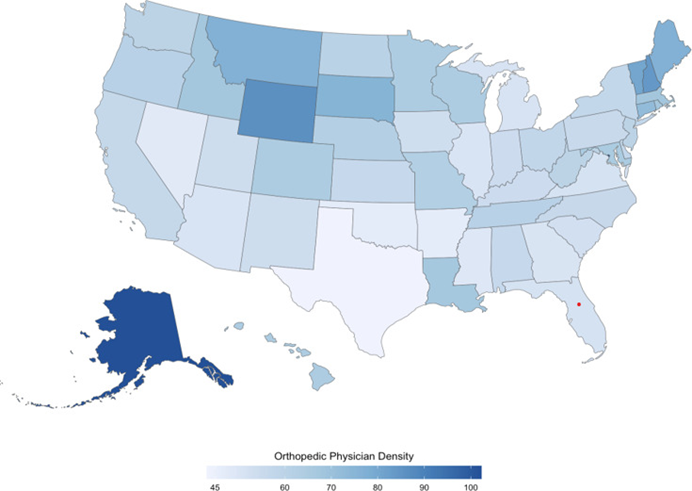
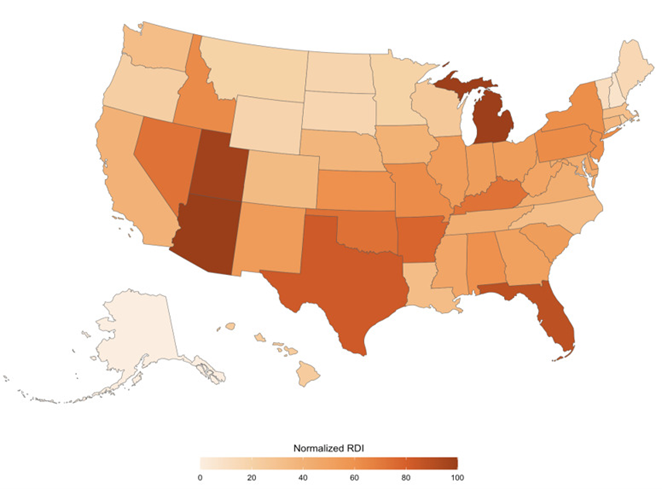
Notably, the concentration of orthopedic surgeons, and demand for orthopedic services, vary geographically, as set forth in the exhibits below:
As a result of these demographic and workforce trends, the supply of orthopedic surgeons may fall behind as demand increases. A 2023 study found that orthopedic surgeons will need to double their total joint arthroplasty (TJA) caseload by 2050, from 65.2 procedures per surgeon in 2017 to 139.4, or increase the number of surgeons by 10% every five years through 2050 to meet demand for that procedure alone.11 Other orthopedic procedures are expected to similarly increase. The most rigorous current estimates project primary total hip arthroplasty to reach 635,000 procedures by 2030, representing 71% growth from 2014. Primary total knee arthroplasty is projected to reach 1.26 million procedures by 2030, representing 85% growth from 2014.12 Revision arthroplasty volumes are projected to increase even more dramatically. By 2060, revision knee arthroplasty is projected to reach 286,740 procedures annually, representing over 520% cumulative growth from 2020.13 Revision hip arthroplasty is projected to reach 61,764 procedures annually by 2060, representing 101% cumulative growth from 2020.14
Patient demographics are also shifting younger; by 2030, 52% of primary hip replacements and 55% of primary knee replacements will be performed on patients younger than 65, fundamentally altering both insurance payor mix and patient expectations for implant longevity.15 This demographic shift has implications for both reimbursement patterns and the types of services offered.
The competitive environment for orthopedic services is characterized by growing demand driven by an aging population and increasing prevalence of obesity and other conditions that contribute to MSDs. At the same time, the supply of orthopedic surgeons faces significant constraints due to an aging workforce. This supply-demand imbalance has important implications for the valuation of orthopedic services and the compensation arrangements between orthopedic surgeons and healthcare organizations.
The next installment of this five-part series will examine the reimbursement environment for orthopedic services, including the Medicare Physician Fee Schedule, recent legislative changes affecting physician reimbursement, and the emergence of value-based payment models in orthopedics.
“Valuation of Orthopedic Services: Introduction (Part 1 of a 5 Part Series)” Health Capital Topics, Vol. 19, Issue 1 (January 2026).
“Prevalence of Obesity and Severe Obesity Among Adults: United States, 2021-2023” By Cynthia L. Ogden, Ph.D., et al., Centers for Disease Control and Prevention, National Center for Health Statistics Data Brief No. 508, September 2024, https://www.cdc.gov/nchs/products/databriefs/db508.htm (Accessed 1/15/26).
“State of Obesity Report 2025” Trust for America’s Health, 2025, https://www.tfah.org/report-details/state-of-obesity-report-2025/ (Accessed 1/15/26).
Ogden, Ph.D., et al., Centers for Disease Control and Prevention, National Center for Health Statistics Data Brief No. 508, September 2024.
“U.S. Physician Workforce Data Dashboard” Association of American Medical Colleges, https://www.aamc.org/data-reports/report/us-physician-workforce-data-dashboard (Accessed 2/25/26).
“A Shortage of Orthopedic Surgeons is Looming” AMN Healthcare, 2024, https://www.amnhealthcare.com/blog/physician/perm/a-shortage-of-orthopedic-surgeons-is-looming/ (Accessed 1/15/26); “The Complexities of Physician Supply and Demand: Projections From 2021 to 2036: Summary Report” Prepared for the AAMC by GlobalData Plc., March 2024, https://www.aamc.org/media/75231/download (Accessed 2/25/26), p. 2
“Anticipating the Next Stage After Medicine: Medscape Orthopedists and Retirement Report 2025” By Jon McKenna, Medscape, August 1, 2025, https://www.medscape.com/slideshow/2025-ortho-retiring-report-6018469?icd=login_success_email_match_norm#1 (Accessed 2/25/26).
“Quantifying Patient Demand for Orthopedics Care by Region Through Google Trends Analysis: Descriptive Epidemiology Study” By Abram Qiu, Online Journal of Public Health Information, January 31, 2025, https://pmc.ncbi.nlm.nih.gov/articles/PMC11804898/ (Accessed 11/19/25).
“FACT SHEET: Orthopaedic Surgeons Will Need to Double Total Joint Arthroplasty Caseload to Meet Demand by 2050” American Academy of Orthopaedic Surgeons Annual Meeting Press Kit, 2023, https://aaos-annualmeeting-presskit.org/2023/research-news/fact-sheet-orthopaedic-surgeons-will-need-to-double-total-joint-arthroplasty-caseload-to-meet-demand-by-2050/ (Accessed 1/15/26).
“Projected Volume of Primary Total Joint Arthroplasty in the U.S., 2014 to 2030” By Steven M. Kurtz, Ph.D., et al., The Journal of Bone and Joint Surgery, Vol. 100, No. 17 (September 5, 2018), https://pubmed.ncbi.nlm.nih.gov/30180053/ (Accessed 1/15/26).
“Projections and Epidemiology of Revision Hip and Knee Arthroplasty in the United States to 2040-2060” By Abiram Bala, M.D., et al., The Journal of the American Academy of Orthopaedic Surgeons, Vol. 31, No. 11 (June 1, 2023), https://pmc.ncbi.nlm.nih.gov/articles/PMC10244911/ (Accessed 1/15/26).
Academy of Orthopaedic Surgeons Annual Meeting Press Kit, 2023.